WHY I PAINT
The Art of Getting Better
People often ask me why I started painting and what motivates me to keep going. The simplest answer, and probably the most honest, is that I want to get good at it. That’s why I paint.
Of course, after all these years, you might think I would have achieved that by now. But painting doesn’t quite work that way. There always seems to be another level to reach, another breakthrough just beyond my grasp.
About twenty-five years ago, I made the transition from working as a traditional signwriter and pictorialist to becoming a plein-air painter.
To many people, it seemed a perfectly natural progression. After all, I was simply exchanging one set of brushes for another.
But I soon discovered that the two disciplines were worlds apart.
Signwriting demanded precision, control and a certain amount of technical discipline. Fine art, particularly plein-air painting, required something quite different. It wasn’t simply a matter of reproducing what I saw, but learning to interpret it.
One of the things that attracted me to painting outdoors was the challenge of capturing a moment in time. The fleeting light, moving shadows, changing atmosphere and the occasional unexpected interruption.
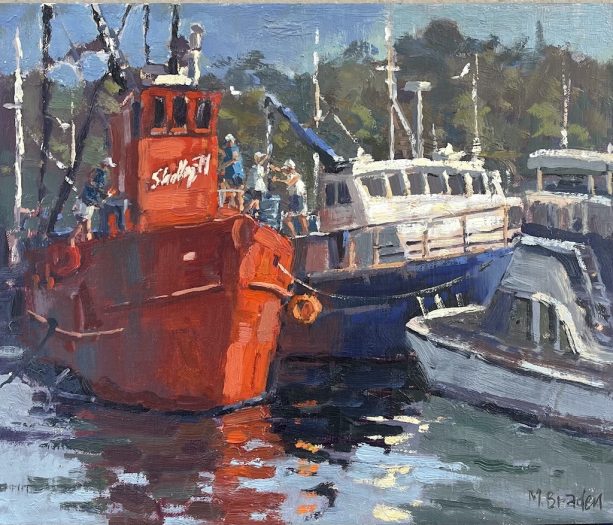
Whether I’m painting a dramatic coastal landscape or an old man sitting on a park bench reading his newspaper in the winter sunshine, the challenge is much the same. How do I capture the feeling of that moment with as few brushstrokes as possible?
It’s a question that has kept me occupied for years.
When I first started painting seriously, progress seemed to come relatively quickly. Each new discovery brought a sense of achievement, and for a while I thought I was getting somewhere.
Then, inevitably, I would reach a plateau.
No matter how hard I worked, my paintings didn’t seem to improve. Eventually, something would click, a small breakthrough would occur, and I would find myself moving forward again.
But it never lasted. Before long, another plateau would appear.
Over the years, I’ve come to realise that these breakthroughs become harder to achieve. Perhaps that’s because, as we develop as artists, our ability to recognise what makes a good painting often improves faster than our ability to actually paint one.
We can see what we’re trying to achieve, but getting there is another matter entirely.
And that’s where the self-doubt creeps in.
I suspect most painters experience this to some degree. We become increasingly critical of our own work, always looking for that elusive something that might lift a painting beyond the ordinary.
For me, the aim has never been simply to paint a more accurate picture. I want to paint more freely, with fewer brushstrokes, allowing the viewer to experience something of what I felt standing in front of the subject.
Perhaps, somewhere along the way, I’ll develop a style that is unmistakably my own.
Until then, I’ll keep chipping away at it.
After all, I’m still trying to get good.
CITY LIGHT -EXHIBITION
 A selection of ‘plein air’ and studio works will be on display at the W gallery from 12th – 23 October 2022. Click on link below for more information.
Covid and the lost art of vacilando
As another Sydney COVID lockdown creeps ever so slowly into its eighth week, restrictions on where and why we can leave our homes look likely to grind on for another couple of months, at best.
The closure of cafés, restaurants, pubs, libraries and just about anywhere else one might seek refuge has left much of the population listless and lethargic, confined to their homes and, for the fortunate ones, still employed.
As most of my painting is done outdoors, I thought I’d check with the local police about the legality of setting up my easel somewhere to paint. After some friendly banter about the ambiguity of my predicament, it was decided that painting did not constitute an essential service. And so, for the time being, I’ve been relegated to studio work.
Of course, a little perspective is useful. While the restrictions are frustrating, I’m grateful not to be living in a country dealing with military invasion, famine or some other catastrophe. I can still take a walk along Sydney’s picturesque harbour, buy fresh produce from the supermarket and, mercifully, pick up a bottle of wine from the boutique bottle shop up the road.
With more time on my hands, I’ve turned to reading. I don’t have social media accounts and have never been particularly interested in Netflix, so literature has become a welcome companion.
Among the books I’ve revisited is John Steinbeck’s Travels with Charley, an account of his journey across America with his dog. In it, Steinbeck introduces a Spanish word that has stayed with me: vacilando.
He describes a traveller who has a direction in mind but isn’t particularly concerned about whether, or when, he reaches his destination. The journey itself is what matters. It’s a notion I’ve always found appealing.
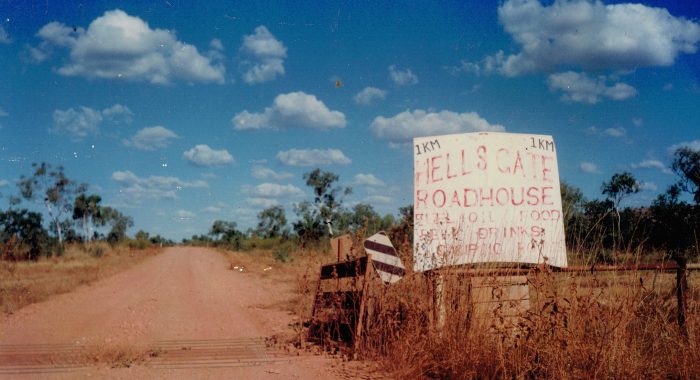
Looking back, much of my own life has been spent vacilando, especially in my teens and twenties, when I travelled around Australia working as a signwriter. There were long stretches on the road, unfamiliar towns and little concern about where I might end up next.
Later, as an artist, I continued travelling, both around Australia and overseas, often with no fixed itinerary beyond finding somewhere interesting to set up an easel. I’ve always enjoyed the freedom of going somewhere without feeling obliged to arrive anywhere in particular.
Perhaps that’s one of the things I’ve missed most during lockdown. Not simply the ability to travel, but the freedom to set out in the morning without knowing quite what the day might bring. The unexpected encounters, the unfamiliar places, the pleasure of taking a wrong turn and discovering something you hadn’t set out to find.
I look forward to the return of that small luxury.
Irena Kurek-Braden (1930–2021)
On 14 May 2021, I was in Canberra clearing out my mother’s house. She was gravely ill in a nursing home, and I knew she would never be returning.
At four o’clock that morning, I received a telephone call from the emergency department at Calvary Hospital. I hurried to the hospital, only to find myself waiting outside while COVID-related paperwork was completed.
Eventually, I was led into a small room where my mother lay. I sat beside her, took her hand and remained with her until she passed away.
My mother, Irena Kurek-Braden, was born in Budapest, Hungary, in 1930. Her early life was shaped by some of the most turbulent events of the twentieth century. She lived through the Second World War and the German occupation of Budapest. Years later, she witnessed the Hungarian Revolution, as Soviet tanks and soldiers moved through the streets.
In 1956, she escaped to Austria, where she spent time in a refugee camp before eventually setting sail for Australia. Here, far from the country of her birth, she began a new life and raised a family.
She was 91 when she died.
I will miss her wisdom and grace. Above all, I will miss her love.
PARIS TO BUDAPEST 2019
To escape the winter, I headed to Europe for a river cruise from Passau, Germany, to Budapest, with Paris as my first stop.
As I was only away for a few weeks, I decided to leave the easel behind and treat the trip as a reconnaissance mission. Taking notes and making small thumbnail sketches would have to suffice.
As an artist, I soon realised that to really get a feel for Paris, one would need to spend several seasons there. A reasonable command of the French language would also help. “Bonjour” and “merci” alone won’t get you very far. I should know, they’re the only two French words I know.
Nevertheless, spending a week wandering the streets of Paris was an absolute delight. As the days slowly gave way to balmy evenings, people gathered to swing dance around the Place de la République, while diners lingered over glasses of wine at pavement cafés and restaurants, enjoying the warm night air beneath the stars.
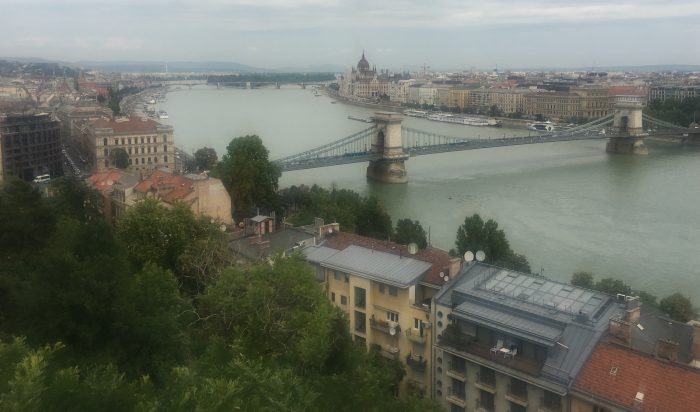
From Paris, I travelled by train to Passau, Germany, where I boarded a riverboat for the journey along the Danube to Budapest. Along the way, I visited Linz, Vienna and Bratislava, each city offering its own particular charm.
I finally disembarked in Budapest, Hungary, the city where my mother was born almost eighty-nine years earlier.
At night, I wandered through Budapest’s famous ruin bar district, spending hours exploring old brick buildings transformed into atmospheric bars and restaurants. Narrow alleyways led to unexpected discoveries, with food, wine and live music adding to the character of this remarkable city.
I will definitely return one day, and next time I’ll bring my easel.
2018 U.S. ROAD TRIP
An American Road Trip: Studying with Kim English
As the year draws to a close and the summer holidays approach, I find myself reflecting, as most people do, on the ups and downs of the past twelve months.
One of the highlights of 2018 was a two-month working trip to the United States, primarily to attend a ten-day painting workshop with the renowned American figurative painter, Kim English.
The workshop was held in Gloucester, a historic fishing town just north of Boston, Massachusetts.
The first couple of days were spent in the studio painting models in three-minute sessions. As soon as the timer sounded, we wiped our paintings from the canvas and started again with another three-minute pose.
The purpose of these exercises was to capture the gesture of the subject, concentrating on mass, tone and the directional lines of the figure rather than becoming bogged down in unnecessary detail and deliberation.
Unlike traditional academic life-drawing sessions, our models wore colourful dresses and used various props, sometimes adopting strenuous poses and at other times simply sitting and reading a book.
Kim pushed us hard during those first two days. We completed around forty studies, and I must admit it was exhausting. However, there was method in this apparent madness. The exercises produced unexpected rewards, both in technical application and in developing a more intuitive approach to painting.
Kim knew exactly what he was doing.
The following days were spent outdoors painting en plein air at Rocky Neck, a well-established artists’ colony on Cape Ann, and at Manchester-by-the-Sea.
Kim gave several painting demonstrations, displaying his natural flair for dynamic, inventive compositions and his brilliant understanding of light.
The workshop concluded with a dinner party, where I said farewell to my fellow students and to a wonderful tutor and gentleman, Kim English.
After Boston, I flew to Los Angeles, hired a car and spent the next six weeks exploring California, travelling between San Francisco and San Diego, with detours to Las Vegas and Palm Springs.
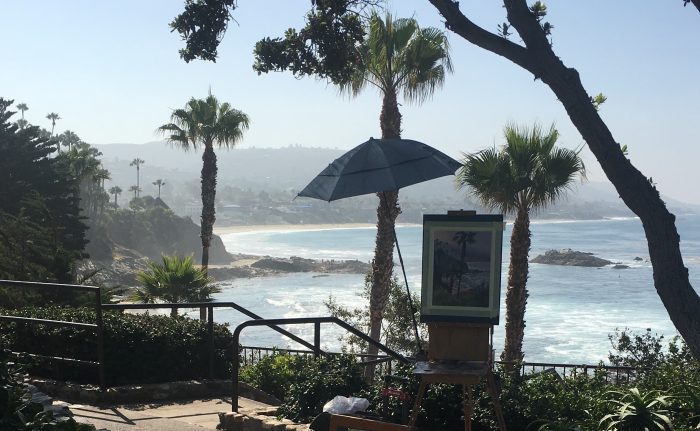
Much of my time was spent searching for interesting places to paint. Naturally, I visited some of the usual suspects, including Heisler Park, Laguna Beach and Crystal Cove, locations that have attracted generations of artists.
So many accomplished painters have worked in these places, producing extraordinary interpretations of the same landscapes. Their achievements have set the bar remarkably high, something I found both discouraging and inspiring in equal measure.
Painting in Maui 2017
Painting in Paradise: A Maui Workshop
A recent plein-air painting workshop on the Hawaiian island of Maui, conducted by John P. Lasater IV and Jason Sacran, proved to be both a timely learning experience and a welcome break.
Both tutors, good-humoured and easygoing, worked tirelessly to convey some rather advanced painting principles, many of which I initially found difficult to grasp. However, their persistence began to pay off.
Scraping away unsuccessful starts, losing edges and refining compositions were among the first of many revelations. These seemingly simple techniques challenged some of my established painting habits. (Thank you, Jason.)
Another revelation was learning to recognise the subtle colours in areas where, at first glance, they didn’t seem to exist. A greenish beige in the shadow of a grey road, for example.
Initially, I simply couldn’t see these colours. It wasn’t until I mixed them and applied them to the canvas that a new awareness began to dawn. (Thank you, John.)
Putting these principles into practice consciously would take some effort, particularly given my stubborn nature. But with persistence, I hoped they would eventually become part of my painting repertoire, something I could do instinctively rather than having to think about every brushstroke.
At the end of each day, I invariably found myself at Spanky’s Bar and Grille, just off the main drag in Lahaina, enjoying Baja-style fish tacos and an ice-cold beer. (Mmmm, beer.)
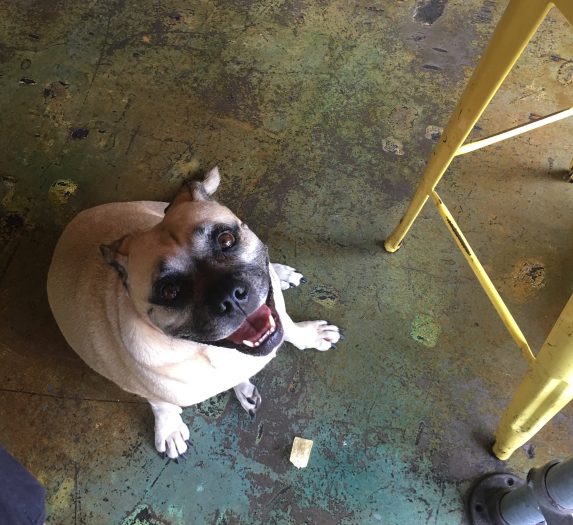
On my final evening at Spanky’s, an unexpected four-legged dinner companion arrived at my table, or rather, at my feet, and happily shared the aforementioned fare.
Sadly, this brief holiday romance came to an abrupt end when the plate was empty.
I eventually departed and wandered down Lahaina’s Front Street, past its bustling bars and restaurants. Streetlamps and flaming torches gently illuminated the dark waters lapping against Maui’s western shore.
Continue reading Painting in Maui 2017
‘Artist’s Palette Magazine’ issue 149, 2016
Crayon on Lounge Room Wall
Lightning Ridge. Australia
Lightning Ridge: Beauty in the Outback
Lightning Ridge, situated just a stone’s throw south of the Queensland–New South Wales border and about 800 kilometres inland from the east coast, is as rich in subject matter for the artist as it is in intriguing inhabitants.
The vast opal fields surrounding the town resemble something of a lunar landscape, interrupted here and there by the makeshift camps and tin sheds occupied by miners and their families.
With no town water or electricity in many of these settlements, residents have become remarkably resourceful. Power comes from solar panels and diesel generators, while some have devised ingenious contraptions, including pedal-powered washing machines assembled from old pushbikes and oil drums.
What often surprises first-time visitors, as they navigate the seemingly endless maze of dirt roads winding through the opal fields, is the ingenuity displayed in the construction of these camps.
Buildings are fashioned from almost anything available: hard ironstone, rough-sawn tree trunks, corrugated iron and even empty beer bottles cemented together. Often, they’re an inventive combination of all of the above.
Yet the landscape is certainly not without its beauty.
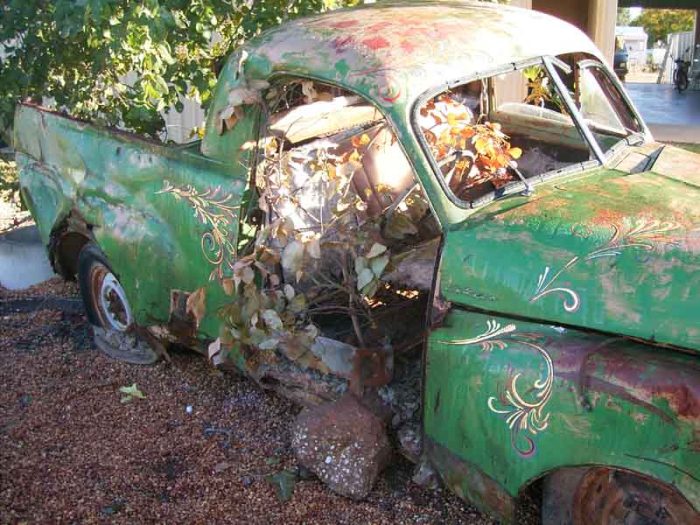
Flowering cacti and native shrubs bring unexpected colour to the dusty surroundings, growing among abandoned working trucks from another era. Bougainvillea in full bloom creeps across old, unroadworthy buses and caravans, finding its way through broken windows and transforming these discarded relics into something unexpectedly beautiful.
A short blog post could hardly do Lightning Ridge justice. There are simply too many outback yarns to tell, from extraordinary rags-to-riches stories to enormous stone castles built single-handedly, not to mention the hot thermal springs and the countless eccentric characters who call the place home.
Needless to say, Lightning Ridge is well worth a visit.