As another Sydney COVID lockdown creeps ever so slowly into its eighth week, restrictions on where and why we can leave our homes look likely to grind on for another couple of months, at best.
The closure of cafés, restaurants, pubs, libraries and just about anywhere else one might seek refuge has left much of the population listless and lethargic, confined to their homes and, for the fortunate ones, still employed.
As most of my painting is done outdoors, I thought I’d check with the local police about the legality of setting up my easel somewhere to paint. After some friendly banter about the ambiguity of my predicament, it was decided that painting did not constitute an essential service. And so, for the time being, I’ve been relegated to studio work.
Of course, a little perspective is useful. While the restrictions are frustrating, I’m grateful not to be living in a country dealing with military invasion, famine or some other catastrophe. I can still take a walk along Sydney’s picturesque harbour, buy fresh produce from the supermarket and, mercifully, pick up a bottle of wine from the boutique bottle shop up the road.
With more time on my hands, I’ve turned to reading. I don’t have social media accounts and have never been particularly interested in Netflix, so literature has become a welcome companion.
Among the books I’ve revisited is John Steinbeck’s Travels with Charley, an account of his journey across America with his dog. In it, Steinbeck introduces a Spanish word that has stayed with me: vacilando.
He describes a traveller who has a direction in mind but isn’t particularly concerned about whether, or when, he reaches his destination. The journey itself is what matters. It’s a notion I’ve always found appealing.
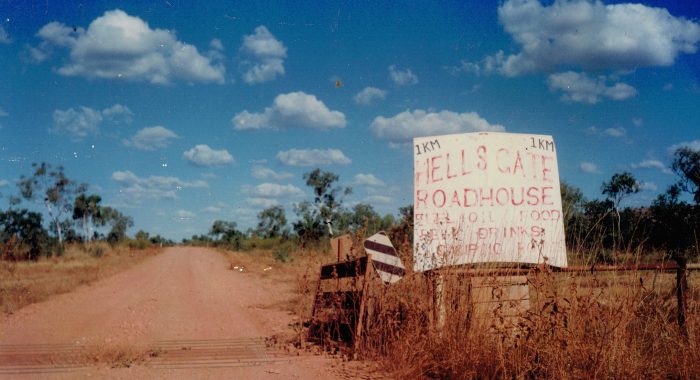
Looking back, much of my own life has been spent vacilando, especially in my teens and twenties, when I travelled around Australia working as a signwriter. There were long stretches on the road, unfamiliar towns and little concern about where I might end up next.
Later, as an artist, I continued travelling, both around Australia and overseas, often with no fixed itinerary beyond finding somewhere interesting to set up an easel. I’ve always enjoyed the freedom of going somewhere without feeling obliged to arrive anywhere in particular.
Perhaps that’s one of the things I’ve missed most during lockdown. Not simply the ability to travel, but the freedom to set out in the morning without knowing quite what the day might bring. The unexpected encounters, the unfamiliar places, the pleasure of taking a wrong turn and discovering something you hadn’t set out to find.
I look forward to the return of that small luxury.
Irena Kurek-Braden (1930–2021)
On 14 May 2021, I was in Canberra clearing out my mother’s house. She was gravely ill in a nursing home, and I knew she would never be returning.
At four o’clock that morning, I received a telephone call from the emergency department at Calvary Hospital. I hurried to the hospital, only to find myself waiting outside while COVID-related paperwork was completed.
Eventually, I was led into a small room where my mother lay. I sat beside her, took her hand and remained with her until she passed away.
My mother, Irena Kurek-Braden, was born in Budapest, Hungary, in 1930. Her early life was shaped by some of the most turbulent events of the twentieth century. She lived through the Second World War and the German occupation of Budapest. Years later, she witnessed the Hungarian Revolution, as Soviet tanks and soldiers moved through the streets.
In 1956, she escaped to Austria, where she spent time in a refugee camp before eventually setting sail for Australia. Here, far from the country of her birth, she began a new life and raised a family.
She was 91 when she died.
I will miss her wisdom and grace. Above all, I will miss her love.