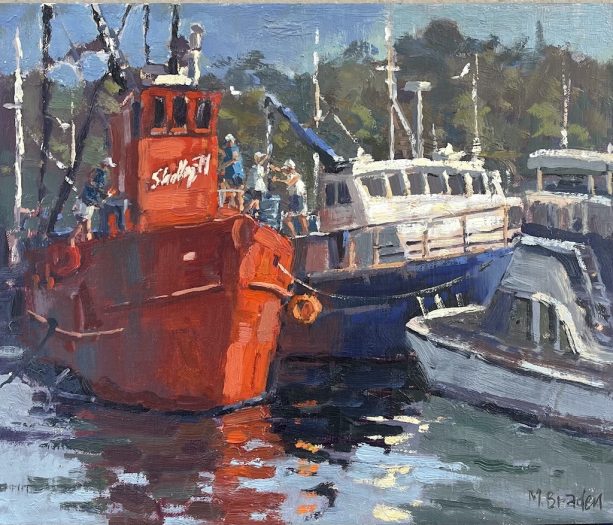
The Art of Getting Better
People often ask me why I started painting and what motivates me to keep going. The simplest answer, and probably the most honest, is that I want to get good at it. That’s why I paint.
Of course, after all these years, you might think I would have achieved that by now. But painting doesn’t quite work that way. There always seems to be another level to reach, another breakthrough just beyond my grasp.
About twenty-five years ago, I made the transition from working as a traditional signwriter and pictorialist to becoming a plein-air painter.
To many people, it seemed a perfectly natural progression. After all, I was simply exchanging one set of brushes for another.
But I soon discovered that the two disciplines were worlds apart.
Signwriting demanded precision, control and a certain amount of technical discipline. Fine art, particularly plein-air painting, required something quite different. It wasn’t simply a matter of reproducing what I saw, but learning to interpret it.
One of the things that attracted me to painting outdoors was the challenge of capturing a moment in time. The fleeting light, moving shadows, changing atmosphere and the occasional unexpected interruption.
Whether I’m painting a dramatic coastal landscape or an old man sitting on a park bench reading his newspaper in the winter sunshine, the challenge is much the same. How do I capture the feeling of that moment with as few brushstrokes as possible?
It’s a question that has kept me occupied for years.
When I first started painting seriously, progress seemed to come relatively quickly. Each new discovery brought a sense of achievement, and for a while I thought I was getting somewhere.
Then, inevitably, I would reach a plateau.
No matter how hard I worked, my paintings didn’t seem to improve. Eventually, something would click, a small breakthrough would occur, and I would find myself moving forward again.
But it never lasted. Before long, another plateau would appear.
Over the years, I’ve come to realise that these breakthroughs become harder to achieve. Perhaps that’s because, as we develop as artists, our ability to recognise what makes a good painting often improves faster than our ability to actually paint one.
We can see what we’re trying to achieve, but getting there is another matter entirely.
And that’s where the self-doubt creeps in.
I suspect most painters experience this to some degree. We become increasingly critical of our own work, always looking for that elusive something that might lift a painting beyond the ordinary.
For me, the aim has never been simply to paint a more accurate picture. I want to paint more freely, with fewer brushstrokes, allowing the viewer to experience something of what I felt standing in front of the subject.
Perhaps, somewhere along the way, I’ll develop a style that is unmistakably my own.
Until then, I’ll keep chipping away at it.
After all, I’m still trying to get good.